
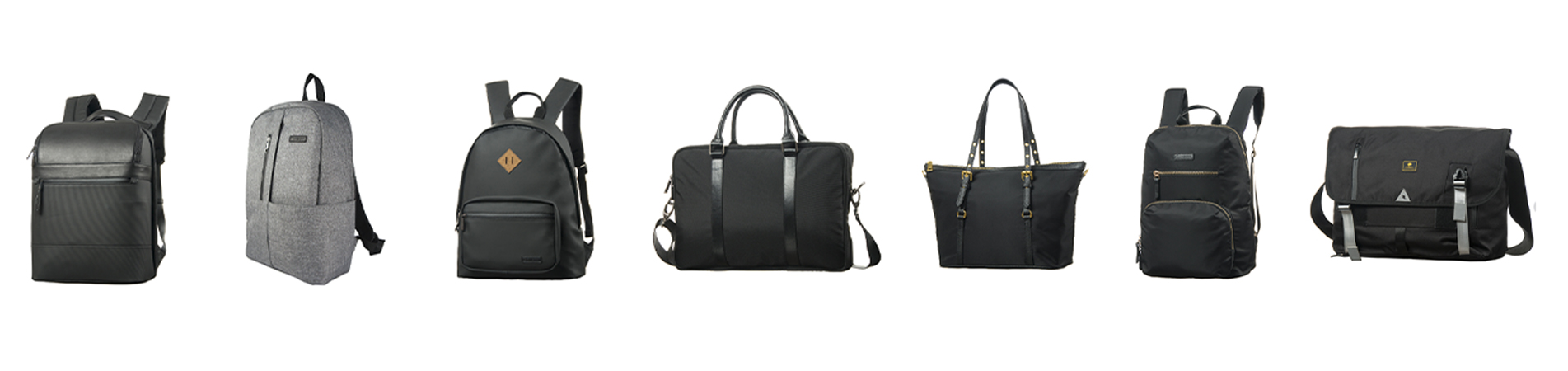
A vacuum compression backpack is a functional backpack equipped with an airtight, compressible compartment and a one-way air-release valve system. Its core mechanism involves placing clothing or other soft items inside a sealed compartment, then removing the air with a manual pump, electric pump, or external vacuum device. This increases the effective packing capacity for soft items such as clothing without increasing the backpack’s external dimensions.
In another word, its primary benefit is to pack more clothing and other soft belongings inside while maintaining the backpack’s overall size. It is important to understand that vacuum compression reduces volume only, not weight.
This article explores the construction and operating principles, compression performance, material selection and manufacturing processes, typical applications, and OEM/ODM customization options for vacuum compression backpacks. It also addresses sourcing considerations such as prototype development, material compliance, and customization coordination, helping brands and procurement teams assess project feasibility at the planning stage.
Contents
Ⅰ. Core Construction and Operating Principles
Ⅱ. Material Selection and Manufacturing Processes
Ⅲ. Typical Applications and OEM/ODM Customization
Ⅳ. Frequently Asked Questions
Ⅴ. Conclusion
A vacuum compression backpack is more than a conventional backpack combined with a vacuum storage bag. It requires the integrated design of the pack body, airtight compartment, air-release valve, and carrying system.
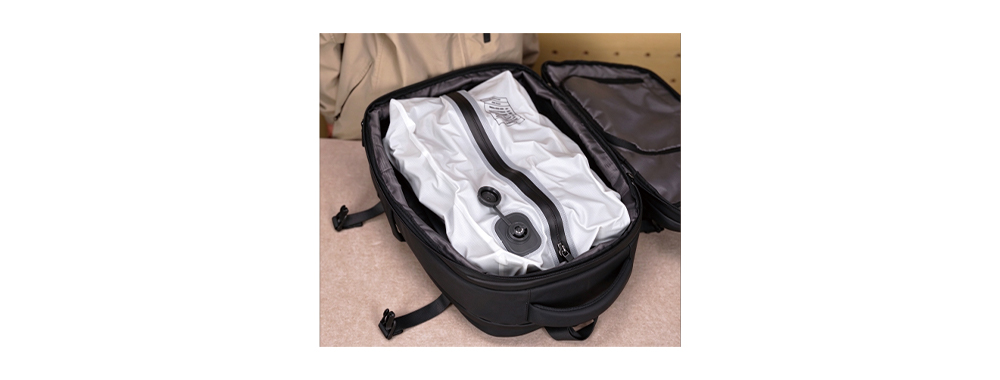
The airtight compartment is the key component for creating and maintaining negative pressure. It is generally made from TPU-laminated film. TPU offers good flex-fatigue resistance and flexibility and can be heat-welded, making it suitable for repeated folding and sealing.
Key structural considerations:
• The backpack’s outer fabric and airtight compartment are separate components. The outer layer provides carrying support, appearance, and abrasion protection, while the inner layer provides the airtight seal and compression function.
• The most common design permanently integrates the airtight compartment into the pack body. Alternatively, buckles, hook-and-loop fasteners, or similar components can be used to create a removable compartment as an optional customization feature.
• The compression area should be designated exclusively for soft clothing and kept separate from the laptop compartment, accessory pockets, and storage areas for rigid equipment. This prevents compression pressure from being transferred to electronic devices or hard items.
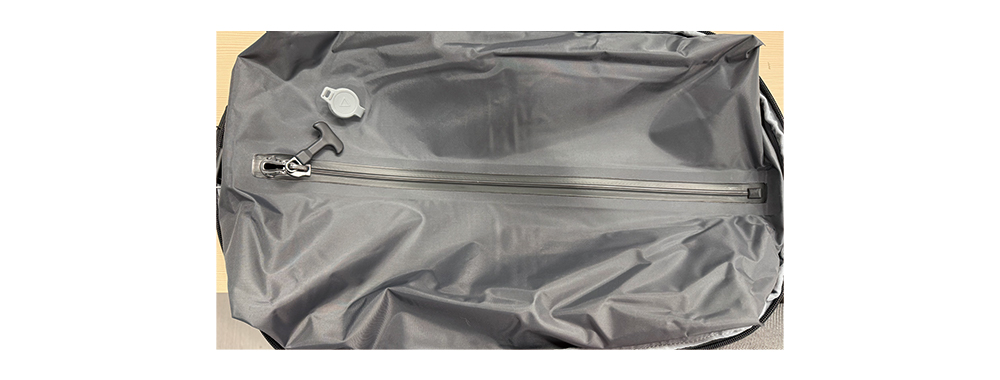
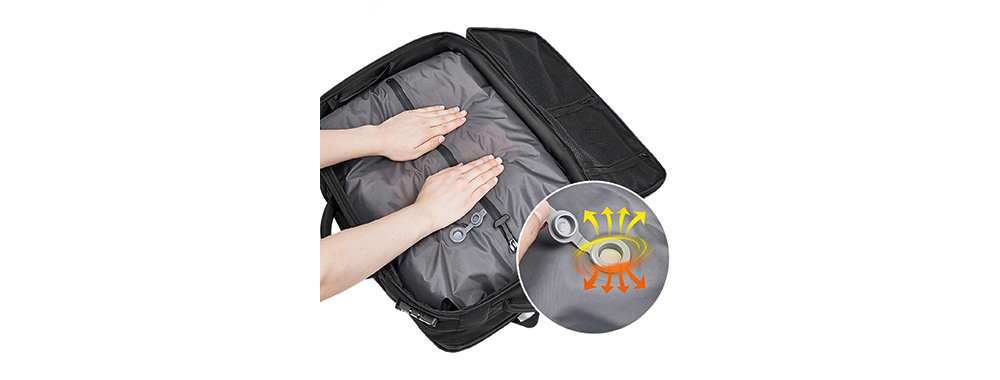
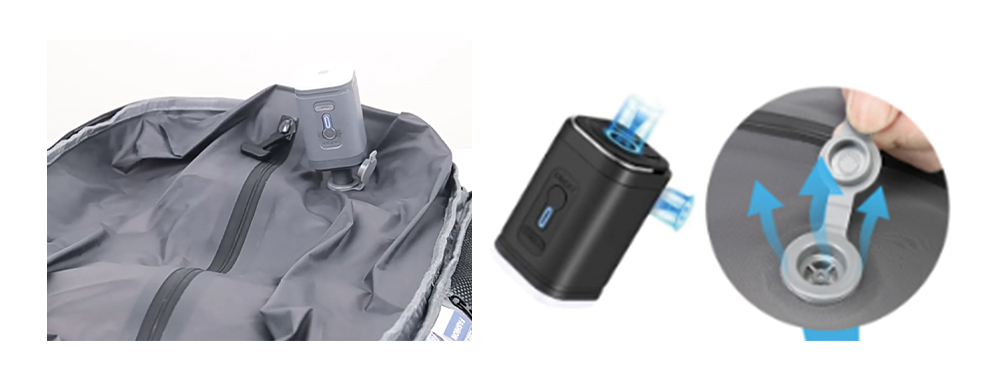
A one-way air-release valve consists of a valve base, an elastic sealing diaphragm, and a dust cap. During air extraction, the diaphragm opens to let air escape. Once pumping stops, the diaphragm closes to prevent air from flowing back into the compartment.
The key performance criterion is the valve’s ability to maintain negative pressure after repeated air-extraction cycles and a period of rest—not simply how quickly it releases air in a single cycle. The valve should be positioned away from areas exposed to pressure from the wearer’s back and from areas where water may collect, while remaining easy to access during pumping.
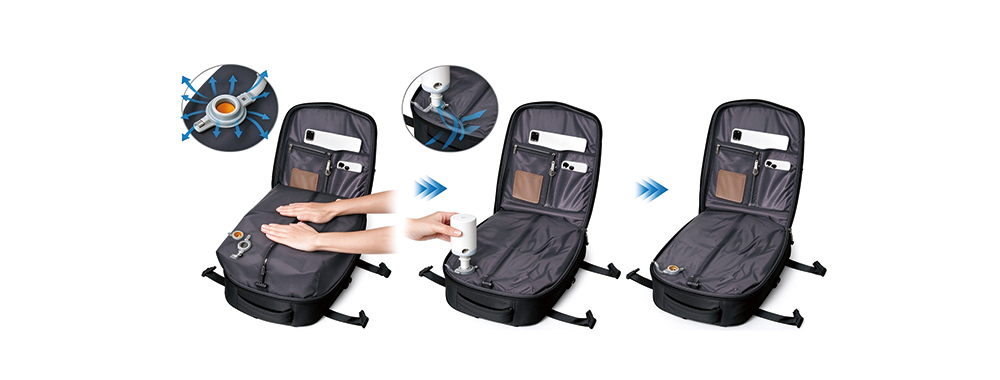
Three pump configurations are commonly used in the market: a built-in pump integrated into the backpack, a separate detachable pump, and a manual pump. Each serves a different product positioning and should be evaluated together with the airtight compartment, valve, and carrying structure during the prototyping stage.
Pump configuration comparison:
|
Configuration |
Positioning |
Advantages |
Limitations |
|
Built-in integrated pump |
Mid- to high-end models |
Integrated into the backpack; no separate accessory to carry or lose; easy to operate |
Adds weight; battery performance may decline at low temperatures; complex integration and more difficult repairs |
|
Separate detachable pump |
A balance of speed and flexibility; a common market option |
Not constrained by the backpack’s internal space, allowing higher airflow options; carried only when needed, so it does not permanently add weight to the pack |
Requires storage for an extra accessory; fit between the valve port and pump head affects extraction efficiency |
|
Manual pump |
Low-cost, lightweight, and emergency option |
No electricity required; lightweight; low maintenance cost |
Longer operating time; more residual air; pumping effort may decrease during continuous use |
Important details:
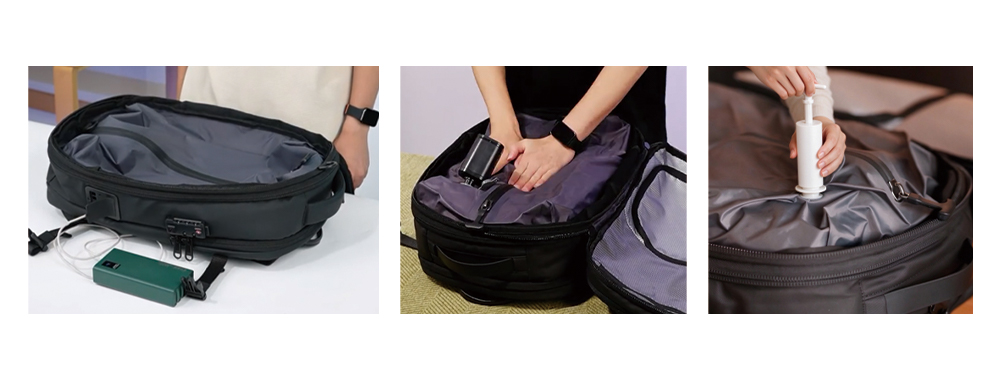
• Built-in integrated pump: The pump is installed on the valve base within the backpack, so the complete pack has no detachable pump accessory. There are two power configurations: a built-in lithium-battery version, which charges via USB-C and can operate independently or while connected to an external power source; and a battery-free version, which must remain connected through USB-C to an external power source such as a power bank, charger, or computer. Manufacturers should consider overall weight, low-temperature battery performance, maximum operating time, and export shipping documentation for electronic components.

• Separate detachable pump: The pump is a removable accessory, while the backpack itself retains only the one-way valve. It is available in both built-in lithium-battery and battery-free USB-powered versions (requiring an external power source). Because it is not constrained by the backpack’s internal space, a separate pump generally offers higher airflow than an integrated miniature pump at a comparable cost. Users can also choose whether to carry it, so the backpack does not permanently bear the additional weight. However, the fit between the valve port and pump connector, as well as hose durability, directly affects air-extraction efficiency.
• Manual pump: Compressing a medium-sized vacuum bag takes approximately 90–150 seconds, with a residual air ratio of around 30%–35%. An electric pump can reduce the residual air ratio to approximately 12%–15% and shorten the process to 45–70 seconds. A manual pump is better suited as a low-cost included accessory or for lightweight, battery-free models; it is not recommended as the primary selling point of a mid- to high-end product.
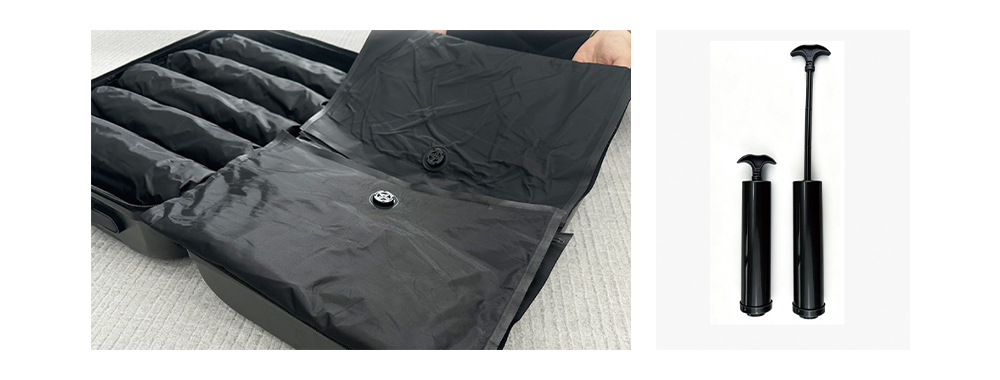
Pump selection recommendations:
For convenient mid- to high-end models, prioritize evaluating a built-in integrated pump. For faster operation or to avoid permanently increasing the backpack’s weight, consider a separate detachable pump. For small initial orders, tight cost targets, complex structures, or lightweight models, a manual or detachable pump may be more appropriate; there is no need to force the integration of an electric pump.
Compression performance depends on the fiber structure of the contents. Different items trap different amounts of air, so their compression ratios can vary significantly. The following figures are for reference:
|
Contents |
Air Retention |
Reference Volume Reduction |
|
Down jackets and padded coats |
Very high |
Approx. 65%–80% |
|
Knitwear, sweatshirts, and fleece |
High |
Approx. 50%–60% |
|
Cotton T-shirts and underwear |
Medium |
Approx. 35%–45% |
|
Denim, khaki trousers, and canvas items |
Low |
Approx. 20%–30% |
The most common quality issues with vacuum compression backpacks are air leakage, cracked weld seams, and declining valve sealing performance. Material selection and heat-sealing/welding processes are therefore critical areas of production control.
The airtight compartment is typically made from a TPU film laminated to a fabric layer. Film thickness must balance airtightness, resistance to negative pressure, and flexibility:
• Film that is too thin: Airtightness becomes less stable after repeated folding.
• Film that is too thick: Flexibility decreases, making stress-related damage more likely at fold lines.
The TPU-to-fabric lamination process directly affects long-term service life. Different constructions vary in peel strength, aging resistance, and flex resistance. During cutting, heat sealing, and folding, manufacturers must control surface cleanliness and material tension to prevent contamination, wrinkles, or localized stress concentrations from compromising the weld-seam seal.
Common outer-shell materials include high-density nylon, Oxford fabric, and polyester, which can be treated with a water-repellent finish. Fabric weight, density, abrasion resistance, and tear strength should be selected according to the product’s positioning.
For models requiring water resistance, the outer fabric and seam-treatment specifications should be determined based on the target market and intended use.
High-frequency welding and heat-press sealing are the most common methods for joining airtight compartments. Sealing performance is affected by fabric specifications, weld-seam condition, and cleanliness during sealing. Airtightness spot checks are typically conducted during mass production to ensure consistent finished-product quality. An airtight zipper opening offers greater convenience, but it costs more and may provide less stable sealing over repeated long-term opening and closing than a heat-sealed opening. The choice should balance ease of use with sealing reliability.
The main methods for joining the valve to the TPU compartment are thermal welding, flat-plate heat sealing, and compression fitting with a sealing gasket. Key assembly controls include ensuring that the joining surfaces are flat and that the sealing surfaces are free from damage.
When an electric pump is selected, the design must also account for pump mounting, airflow-channel alignment, battery-compartment layout, and dust- and water-resistant construction. The integration of electronic components with the backpack structure should be repeatedly validated during prototyping. For backpack OEM/ODM projects, the factory selects the valve model, air-extraction configuration, and accessory suppliers according to the product positioning, then confirms the complete structure during the pre-production sample stage.
Once compressed, clothing forms a compact mass inside the compartment. Positioning it close to the back panel can reduce movement while walking. This places corresponding requirements on the carrying system: the shoulder straps and back-panel support structure must accommodate the compressed load so that the center of gravity sits closer to the wearer’s body.
During pattern development, the curvature of the back panel, shoulder-strap thickness, and sternum-strap position can be adjusted according to the target capacity and compartment layout. For models designed primarily for commuting and business travel, carrying stability is just as important as the compression function, and both should be evaluated when the pattern is finalized.
• Travel and air travel: Airlines in Europe and North America continue to enforce carry-on size limits, and bags that fail gate-size checks may incur additional charges. The key advantage of a vacuum compression backpack is that it can remain within the target airline’s carry-on size limits while increasing the amount of soft clothing it can hold without changing its external dimensions.
• Outdoor activities and short trips: Suitable for short camping trips and hikes, the backpack can compress bulky winter gear to free up main-compartment space. The compression structure can be integrated into outdoor backpacks and travel bags.
• Business travel and commuting: A business backpack can use a removable airtight compartment to support both everyday commuting and short business trips. The laptop compartment and compression compartment should be structurally separated to ensure that compression pressure is not transferred directly to the electronics compartment.
• Sports and fitness: The design can store soft items such as workout clothes and towels and can be incorporated into gym bags and sports backpacks.
• Emergency storage and organization: Suitable for storing seasonal clothing and backup soft gear, this concept can support product lines designed for both travel organization and home storage.
Comparison Factor Vacuum Compression Backpack Compression Straps / External Cinching Conventional Storage Bag
Operating principle A one-way valve removes air from the compartment to create and maintain negative pressure External force compresses the contents and pushes air out from between fibers, but cannot maintain negative pressure Separates and organizes items
Volume reduction of soft clothing Relatively high; depends on the fabric and contents Usually only a few to just over ten percent; contents visibly rebound after resting Little to no volume reduction
Pack shape More likely to retain a smooth, even profile Can develop localized bulges and become misshapen Does not change the pack’s external shape
Protection of contents Airtight compartment helps block moisture and splashes Contents remain directly exposed to ambient moisture Contents remain directly exposed to ambient moisture
Typical applications Travel involving a high proportion of soft clothing Heavy-load carrying and external compression/securement Item organization and everyday storage
The key differentiator is the ability to maintain negative pressure. External straps rely on mechanical force to compress the contents and expel air trapped between fibers; once the force is released, the contents tend to rebound. By contrast, a vacuum valve can maintain negative pressure after air extraction, resulting in more consistent volume reduction.
• OEM, based on customer-provided designs and samples: The brand supplies the Tech Pack, structural drawings, material specifications, and logo artwork. The backpack factory develops samples and proceeds to mass production according to the requirements. This approach is suitable for projects with an established structural design.
• ODM, using and modifying existing models: The customer selects an existing backpack pattern and airtight-compartment structure from the factory, then adjusts the fabric, color scheme, logo application, selected functions, and packaging. This option helps shorten development lead times and accelerate product launches.
• Light customization for market testing: Based on an existing structure, non-structural components such as the logo, colors, webbing, zipper pulls, and packaging can be changed. This is suitable for emerging brands and cross-border e-commerce sellers testing market demand.
A: Airtight reliability is determined jointly by the film substrate, weld-seam edges, and valve connections. Common validation methods include weld-sample inspection, negative-pressure retention tests on the compartment, and repeat airtightness tests after multiple air-extraction and release cycles followed by a resting period. Test frequency and acceptance criteria for different product grades can be agreed upon when the order is confirmed.
A: European and North American markets have specific compliance requirements for bag fabrics, coatings, hardware, accessories, and chemicals. A vacuum compression backpack may contain TPU film, outer fabric, water-repellent treatments, webbing, sewing thread, and hardware. These materials should undergo the relevant testing and documentation procedures for the target market. Common compliance frameworks and programs include REACH, California Proposition 65 (CA Prop 65), and OEKO-TEX. The exact test list depends on the order requirements and applicable local regulations.
A: Yes. A removable airtight compartment can be secured inside the backpack using zipper tracks, buckles, or hook-and-loop fasteners. This allows the user to switch between business commuting and short-trip configurations and makes it easier to replace the compartment if it is damaged. However, it adds the cost of zippers or buckles. The interfaces also require sealing and load-bearing validation, and the compression-compartment boundaries and backpack pattern must be adjusted accordingly.
A: An integrated electric-pump system includes the pump, battery, wiring, and airflow-channel components. Key considerations include secure pump mounting, heat dissipation, dust and water resistance, and electronic-component reliability. The relevant lithium-battery shipping documentation must also be prepared for export. For smaller orders or complex structures, a manual pump or separate detachable pump may be recommended as an alternative.
A: With an independent-compartment design, the airtight compression compartment is separated from the laptop compartment, so negative pressure is not transferred to the electronics compartment. By planning the compartment boundaries and lining structure during pattern development, manufacturers can achieve both compression storage and device protection.
A vacuum compression backpack is a functional bag that places high demands on airtight construction, material compatibility, and heat-sealing processes. Product consistency depends on the coordinated design of the TPU compartment, one-way valve, pump configuration, and backpack structure.
As a bag OEM/ODM manufacturer, we can provide structural assessments, material selection, logo-application development, sample development, and mass-production services. If you are planning a vacuum compression backpack project, please share your target market, backpack capacity, compression-compartment ratio, preferred pump configuration, and estimated initial order quantity. We will provide professional recommendations to help you select the right solution.
| Author | ||||||
|
계속 읽어보시고, 계속해서 소식을 받아보시고, 구독하세요. 귀하의 생각을 알려주시면 감사하겠습니다.




저작권
@2024 Synberry Bag & Package Products Co.,Ltd 모든 권리 보유
.
 네트워크 지원
사이트맵 / 블로그 / Xml / 개인 정보 보호 정책