기치
블로그

Guide to rPET Fabric

블로그

Guide to rPET Fabric

December 29, 2025

I. What is rPET?


rPET stands for Recycled Polyethylene Terephthalate. It is a type of recycled plastic material made from post-consumer or post-industrial PET plastic. After being cleaned, processed, and reprocessed, the plastic is turned into a new product. By recycling waste materials, manufacturers can produce new products without relying on fossil fuels like oil and natural gas. This not only reduces waste but also helps to minimize the environmental impact of plastic production. Although rPET is still plastic, it represents a step in the right direction towards a more sustainable future.


II.  The Production Process of rPET:


1. Main Sources:

  • The largest and most common source is recycled PET plastic bottles (such as beverage bottles, water bottles, etc.).
  • A smaller portion comes from other PET packaging, such as recycled materials from food trays, polyester textiles, and more.

PET plastic bottle

2. Shredding into Flakes:

These materials are thoroughly cleaned and sorted, then shredded into small, uniform pieces called flakes. These flakes serve as the base raw material for new fibers.

 PET sheet

3. Melting and Resin Formation:

The plastic flakes are melted and reprocessed into a high-quality recycled material known as resin or plastic pellets. This step is crucial as it optimizes the chemical properties of the recycled PET, ensuring it meets the performance requirements of new, high-quality polyester or nylon resins.

 PET particles

4. Extrusion and Spinning (Yarn Formation):

In the textile industry, rPET resin pellets are melted and extruded into fine filaments, which are then spun into yarn.

 Squeezing yarn

5. Fabric Production:

Textile factories purchase rPET yarn and weave it into various fabrics, which are then used for clothing, home textiles, outdoor products, and more.

  Fabric manufacturing

6. Finished Product Production (Consumer Goods):

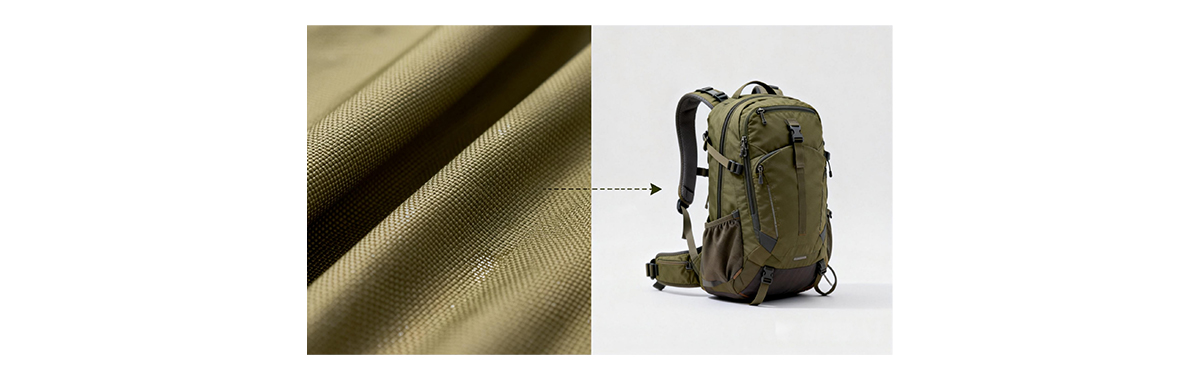
Backpack factories or other apparel, home goods, and industrial factories use rPET fabric to produce final products such as backpacks, clothing, footwear, and other consumer goods.

finished product production

In simple terms, rPET is the "new material made from recycled plastic bottles," or the process of "bottle to fabric." However, the manufacturing process of rPET has not yet fully achieved a closed-loop cycle:


  • Established Pathway: As mentioned earlier, recycled PET plastic bottles → rPET fibers (bottle to fabric). The process involves recycling post-consumer PET bottles → cleaning, shredding → melting and granulating → spinning/molding → producing new textiles.


  • Emerging Pathway: Waste textiles → rPET fibers (fabric to fabric). Once textiles reach the end of their lifespan, they are re-entered into the recycling system. Although this process shares similarities with the recycling of plastic bottles to produce rPET, it faces greater challenges due to the uniqueness of textiles (such as mixed fibers, dyes, chemicals, zippers, buttons, etc.). The process is more complex and requires refined procedures, including sorting, impurity removal, cutting and loosening, deep cleaning, melting, and granulating. Currently, due to industrial and market limitations, widespread adoption of this pathway is difficult. Therefore, while the "bottle to fabric" to "fabric to fabric" closed-loop model is technically feasible, it is not yet widely industrialized and remains a niche solution.


Below are the two pathways for rPET fabric manufacturing:

rPET manufacturing process


III. Application of rPET in Backpack Manufacturing


The use of rPET in backpack manufacturing is growing rapidly and is currently in the stage of transitioning from high-end to mainstream markets. Below is a detailed analysis of its applications, advantages, challenges, and market significance:


1. Specific Applications of rPET in Backpack Manufacturing:


1.1 Primary Material Application:

rPET material is directly used as the main fabric for backpacks, covering a variety of weaving styles:

  • Oxford fabric, canvas: Used for the outer layer of the backpack, providing structural support.
  • Filament fabric and stretch fabric: Lightweight designs, ideal for urban commuter backpacks.
  • Jacquard fabric and checkered fabric: Meets the design needs for fashionable styles.


1.2  Functional Lining:

  • rPET fabric is widely used for the lining inside backpacks, as it has relatively lower requirements for color and strength, making it effective for utilizing various grades of recycled materials.


1.3 Auxiliary Materials and Accessories:

  • Mesh fabric: Used in the carrying system to enhance ventilation; recycled mesh fabric is now widely used in high-end backpacks.
  • Fleece fabric: Used as a protective layer for electronic device compartments.
  • Webbing: Increasingly, rPET is being used for the webbing on backpack straps, chest straps, handles, etc.
  • Zippers: Some brands are now using rPET materials for the fabric of zippers.
  • Foam padding: The cushioning foam in the back panel and shoulder straps may also contain recycled components.


1.4 Plastic Components:

  • Some buckles, snap fasteners, and other injection-molded parts can also be made using rPET pellets, which are directly injection-molded to achieve a higher proportion of recycled material usage.


2. Advantages of Application


2.1 Environmental Benefits:

  • Reduction in petroleum consumption: Helps reduce reliance on fossil fuels.
  • Lower carbon emissions: The energy consumption and CO₂ emissions from producing rPET fibers are about 30%-50% lower than those of virgin polyester.  
  • Waste reduction: Gives discarded plastic bottles a new life, preventing them from ending up in landfills or the ocean.
  • Water conservation: The production process consumes less water compared to virgin polyester or cotton.


2.2 Excellent Performance:

  • rPET fibers are comparable to virgin polyester in terms of strength, durability, wrinkle resistance, and ease of care. They fully meet the high standards for abrasion resistance, lightweight design, and durability required in backpack manufacturing.


2.3 Brand Value and Market Competitiveness:

  • Meeting consumer demand: Increasingly, consumers, especially younger generations, prefer to choose eco-friendly products.
  • Building brand image: Using rPET is a strong demonstration of a brand's commitment to social responsibility and sustainable development.
  • Compliance with regulatory trends: Globally, the demand for recycled material content in products is steadily rising.


3. Challenges and Limitations


3.1Supply Chain and Technical Barriers:

  • The supply of high-quality, color-stable, and consistently performing rPET fabrics is still not as abundant as virgin fabrics. Additionally, it requires advanced recycling, sorting, and processing technologies.
  • Achieving a "closed-loop" recycling system (where used backpacks can be recycled into new backpacks) is still technically and commercially challenging. Currently, most systems are still "open-loop" downcycling.


3.2 Cost Issues:

  • Due to the complex processes of recycling, cleaning, and processing, high-quality rPET fabrics can sometimes be more expensive than virgin fabrics, although the cost gap is shrinking.


3.3  Balancing Performance and Design:

  • To achieve extreme durability or specific features (such as superior waterproofing), some high-end backpacks still prioritize certain virgin high-tech fabrics.
  • In terms of coloring, rPET is typically better suited for "dope dyeing" (adding colorant pellets during the spinning process) to reduce water pollution, but this limits the flexibility in color options.

Overall, the use of rPET in backpack manufacturing has shifted from being a "niche eco-friendly choice" to a "mainstream industry practice." It has not only made a tangible contribution to environmental protection but has also become a key element in brand innovation and market competition. In the future, with advancements in technology, improvements in recycling systems, and the ongoing rise in consumer awareness, the application of rPET and other recycled materials in backpacks, as well as in the broader outdoor and everyday consumer goods sectors, will become even deeper and more widespread.


IV. How Can Consumers Verify the rPET Content? (Traceability of rPET)


As brands shift towards using sustainable materials like rPET, certification becomes essential to verify the authenticity and traceability of the products. GRS (Global Recycled Standard) is the leading certification in the field of recycled fibers and fabrics, ensuring transparency throughout the entire process, from raw materials to finished products.

GRS Certification Label

GRS certification mark

  • What is GRS?

GRS stands for Global Recycled Standard, an internationally recognized standard established by the Textile Exchange. The GRS certification aims to track and verify the content of recycled materials in final products, ensuring that the production process meets environmental and social responsibility criteria. It is applicable to recycled materials such as rPET, recycled nylon, and recycled cotton.


Core Elements of the Standard


1.Main Objectives:

  • Recycled Material Verification: Ensures that the recycled materials declared in the product (such as recycled polyester, recycled cotton, etc.) are authentic and verified throughout the entire supply chain.
  • Environmental Protection: Requires companies to reduce the use of harmful chemicals, conserve water resources, and save energy during the production process.
  • Social Responsibility: Ensures that production processes adhere to labor rights standards, such as prohibiting forced labor and safeguarding workers' health and safety.
  • Traceability: Establish a complete traceability system from raw materials to finished products, preventing false claims. 


2. Scope of Application

GRS applies to all products containing at least 20% recycled materials and covers industries including:

  • Textiles (e.g., clothing, footwear, home textiles)
  • Plastic products
  • Packaging materials
  • Other end products containing recycled materials


3. Certification Core Requirements

  • Material Classification for Recycling:

Pre-consumer materials: Waste generated during the production process (e.g., factory offcuts).

Post-consumer materials: Products that are recycled after being used by consumers (e.g., plastic bottles, old clothes).

  • Eco-friendly Production:Limit the use of chemicals, encourage energy conservation, emission reduction, and wastewater treatment.
  • Social Responsibility:Comply with the International Labour Organization (ILO) standards and safeguard workers' rights.
  • Supply Chain Traceability:Require companies to hold GRS (Global Recycled Standard) certification to ensure that recycled materials can be traced at every stage


4.Certification Process

  • Companies apply to a third-party certification body (e.g., Control Union, IDFL, etc.).
  • The audit includes document review, on-site inspection, and supply chain traceability verification.
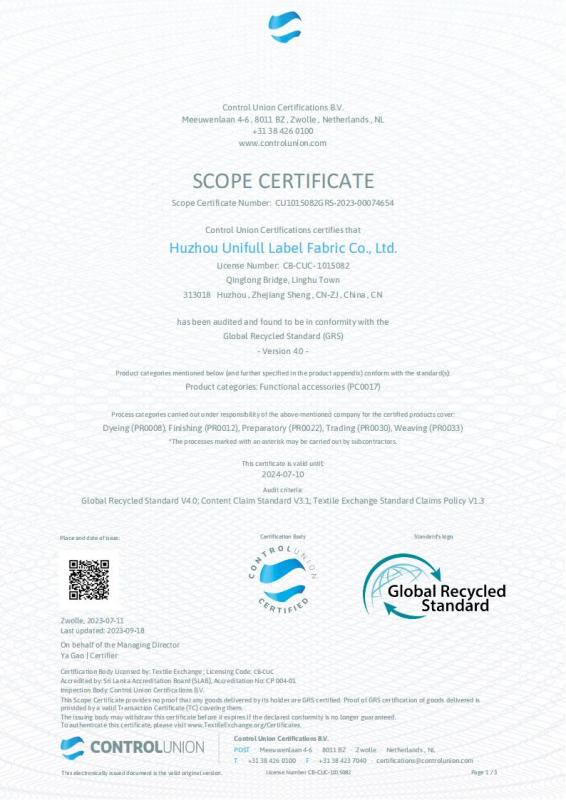
  • After passing the GRS (Global Recycled Standard) certification process, a SC (Scope Certificate) with the GRS logo is issued. The SC certificate serves as the company’s qualification certificate. In a broader sense, the term “GRS certificate” usually refers to the SC certificate.

Example of a GRS (SC) Certificate

GRS (SC) Certificate Example

GRS Certification Process

GRS certification process

5. GRS vs. Other Standards

  • GRS vs. RCS (Recycled Claim Standard):RCS is a more basic standard that only verifies the content of recycled materials, while GRS additionally covers environmental and social responsibility requirements.
  • GRS vs. GOTS (Global Organic Textile Standard):GOTS focuses on organic fibers, while GRS focuses on recycled materials.


TC Certificate (The "Environmental ID" of Recycled Products)

Factories or suppliers certified by GRS issue a Transaction Certificate (TC) for each batch of rPET products. This certificate confirms the content, weight, and the production and sales traceability of the rPET.

Key Points of the TC Certificate:

1. What is its essence?

  • It is not a qualification certificate granted to the company, but rather a transaction certificate for a specific batch of goods. Every time a transaction involving certified materials (e.g., recycled materials) takes place, a separate TC certificate must be issued for that batch.

2. Why is it needed? (Main purposes)

  • Traceability: It tracks the complete flow path of recycled materials from recycling, processing, spinning, weaving, dyeing, to the finished product, ensuring that the “recycled content” claim is accurate and preventing false advertising.
  • Ownership Statement: It verifies that the recycled content in a batch of goods has been certified. For example, if a batch of fabric claims to contain 50% GRS recycled polyester, the TC certificate is the official endorsement of that claim.
  • Compliance in Trade: Only goods with a valid TC certificate can be accepted by downstream GRS-certified companies and used to produce new GRS-certified products. It serves as the "passport" for compliance within the supply chain.


3. What key information is included in the certificate?

  • TC Number: A unique identifier used for inquiry and traceability.
  • Buyer and Seller Information: The names, addresses, and certification numbers (SC Code) of both the shipper and the recipient.
  • Description of Goods: Product name, quantity, and weight.
  • Recycled Material Information: Recycled material content percentage (e.g., 50%), material type (e.g., post-consumer recycled polyester), and standard (GRS or RCS).
  • Transaction Date: Date of shipment.
  • Certification Body: The organization that issued the TC.


4. How to obtain the TC certificate?

  • Prerequisite: Both the buyer and seller must be companies certified under the relevant standard (e.g., GRS).
  • Application Process:

1)The buyer and seller complete a transaction involving certified materials.

2)The seller submits an online TC application to their certifying body.

3)The seller must provide evidence showing that the goods were produced using inputs from their certified scope and that their upstream supply chain also has corresponding valid TC certificates as input evidence.

4)After review, the certifying body issues the TC certificate for that batch of goods and sends it to both the buyer and seller.

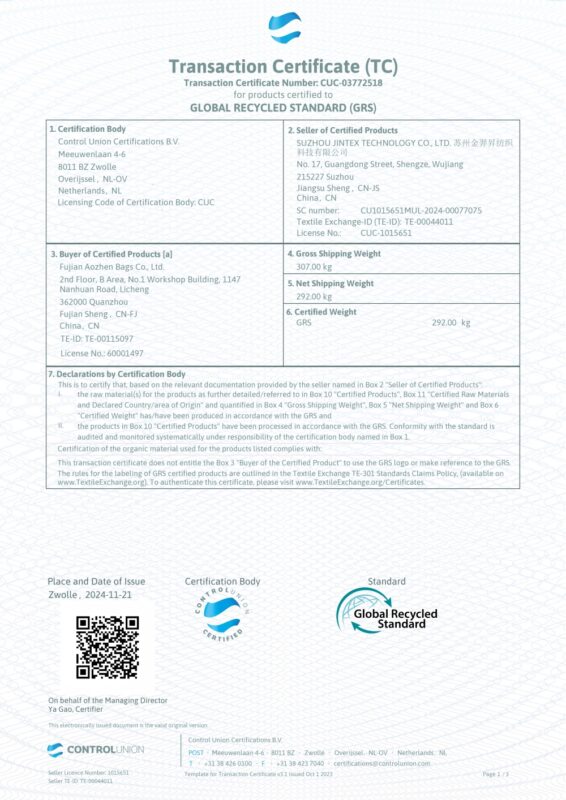
Example of a TC Certificate Issued for rPET Fabric

TC Certificate Example

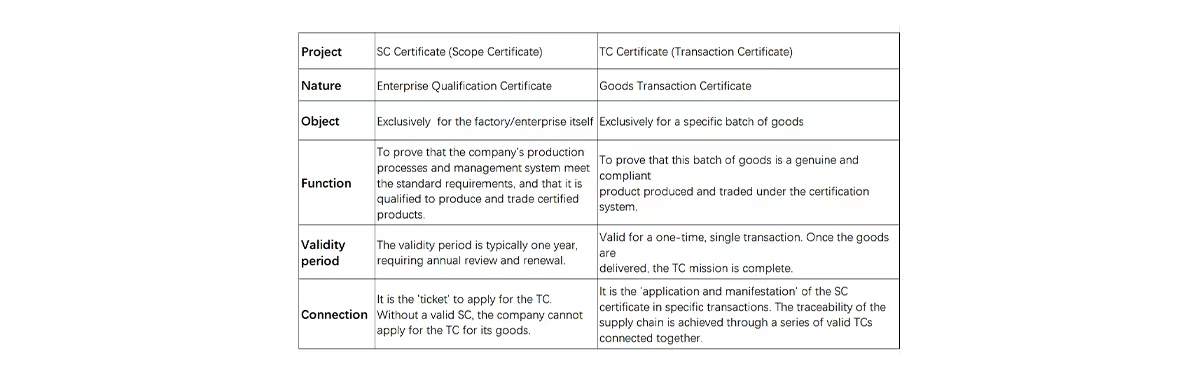
  • The Relationship Between TC Certificate and GRS (SC) Certificate (Very Important)

The relationship between TC certificate and SC certificate

Summary:

  • Without a GRS (SC) Certificate, there can be no TC Certificate. This is the prerequisite.
  • A product with only a GRS (SC) Certificate but without a TC Certificate cannot be considered a GRS-certified product. While a company may have passed certification, if a particular batch of goods has not applied for a TC, that batch cannot be labeled as a GRS product in the market. Furthermore, downstream companies cannot use it to produce their own GRS-certified products.
  • The credibility of the entire GRS system ultimately depends on the complete chain of TC Certificates.
  • Therefore, the GRS Certificate is the "qualification," and the TC Certificate is the "proof." Together, they ensure transparency and credibility of recycled materials from the source to the end product.


V. How Can We Ensure Compliance as a Manufacturer?

As a manufacturer producing rPET bags and backpacks, our approach includes:

Step 1: Supplier Certification

  • Collect and verify the GRS SC certificates of all potential rPET suppliers.
  • Clearly specify in the procurement contract that they must provide a valid TC certificate for each batch of goods.


Step 2: Compliant Procurement

  • When placing orders, clearly specify that the materials must be GRS-certified.
  • Upon receipt of goods, verify that the physical products match the information on the accompanying TC certificate.
  • Archive the TC certificate along with the purchase order and the goods receipt note.


Step 3: Establish Internal Systems

  • Develop a GRS material management procedure (covering procurement, warehousing, production, and documentation).


Step 4: Production and Application

  • Before production, isolate GRS-certified materials and the production line.
  • Produce according to the order and keep detailed records.
  • Before shipping the products, apply for a TC certificate for your products from the certifying body, using the raw material TC and your own production records.
  • Provide the issued TC certificate along with the goods.

The ultimate goal of compliance management for manufacturers is to create a complete and trustworthy closed loop, from the raw material TC (input) → internal traceability documents → final product TC (output). This is not only about passing certification, but also about building brand credibility and gaining long-term competitive advantage in the green economy.


VI . Conclusion


The construction of the rPET industry chain is not only a technological innovation but also a reshaping of societal values. It makes every consumer realize that the plastic bottle in their hand is not waste, but a valuable resource that can be reborn. It helps every company understand that environmental protection is not a cost burden, but the core of future competitiveness. As more and more brands join this green revolution, and as more consumers vote with their purchasing behavior, we are actually writing a new social contract together — human development must be based on respecting the earth’s carrying capacity.

By customizing backpacks with rPET, you allow consumers to feel your environmental commitment and help turn recycled plastic bottles into a unique green story for your brand. We look forward to working with you!

  Author  


핫 태그 :
문의하기
주소 : Unit 905, Block B, Jinri Building, No. 88 Anling Second Road, Huli District, Xiamen, Fujian, China
연락하기

계속 읽어보시고, 계속해서 소식을 받아보시고, 구독하세요. 귀하의 생각을 알려주시면 감사하겠습니다.

Linkedin WhatsApp Facebook instagram

저작권 @2024 Synberry Bag & Package Products Co.,Ltd 모든 권리 보유 . 네트워크 지원

사이트맵 / 블로그 / Xml / 개인 정보 보호 정책

메시지를 남겨주세요

메시지를 남겨주세요
우리의 전문 지식이 어떻게 최고 품질의 매력적인 제품을 제공할 수 있는지 논의하게 되어 기쁩니다. 여기에서 대화를 시작하세요. 연결하고 창조해 봅시다!
제출하다

제품

왓츠앱

문의하기